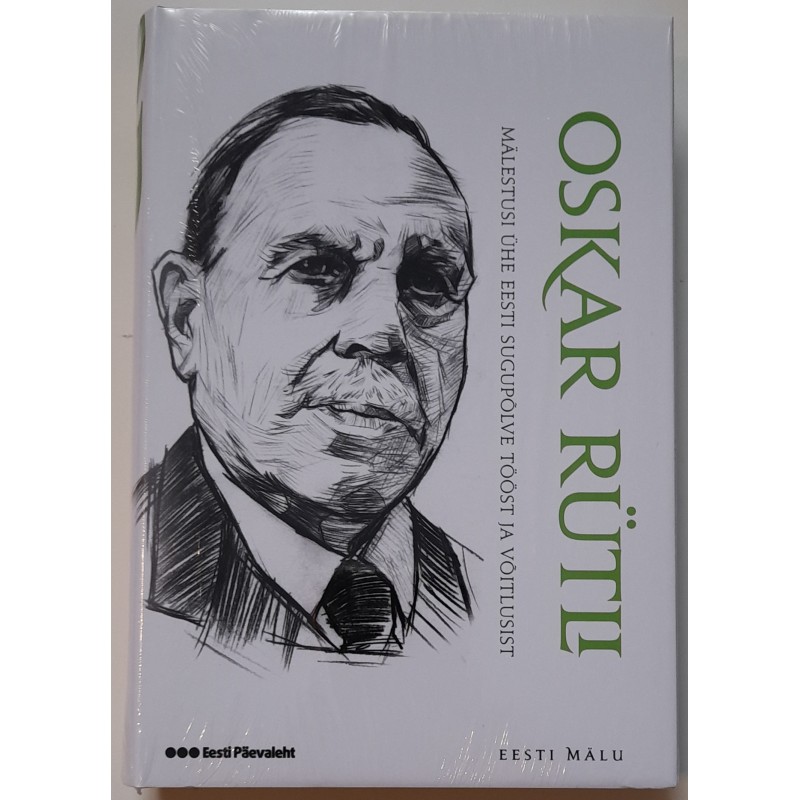


Memories of the work and struggle of an Estonian generation - Oskar Rütli
Publisher: Eesti Päevaleht
City: Tallinn
Year: 2010
Pages: 512
Condition: the book is in a plastic package, an unused book
Size: standard format, with hard covers
Written in Germany in 1949, the work with the telling subtitle «Memories of Oskar Rütli. About the work and struggles of one generation of Estonians (1871–1949)» was published in New York in 1964. This is the spiritual testament of a man with an excellent memory who has worked on the front line of Estonian life and interacted with many figures of the state, intellectual and economic life, but kept himself in the background for future generations.
Oskar Rütli worked his way up to a well-known economic and social figure and allegedly one of the richest Estonians even before the First World War.
Rütli was born on December 19, 1871 in the village of Ibaste, Ahja municipality, Tartu county, as the son of a tenant farmer, studied at Võnnu parish school, Hugo Treffner high school and Aleksandri high school in Tartu, and graduated from the Faculty of Law of the University of Tartu in 1901. He was a member of the Estonian Students' Society and then one of the founders of the Sakala corporation in 1909, and from 1902 to 1940 he worked as a barrister in Tartu, and was a leading figure in the national initiatives and organizations of the Estonian people, as well as for-profit organizations, which rapidly raised their heads at the beginning of the 20th century. He was elected together with Jaan Tõnisson as a representative of the Livonian peasantry to the First State Duma of Russia in 1906. During the Republic of Estonia, Rütli was a member of the II Riigikogu, the First Chamber of the National Assembly and the Council of State, was the consul of Finland in Tartu, was a member of the advisory board and board of several banks, was on the board of several industrial companies and the founder and director of AS Tartu Telefonivabrik, an active firefighter and legal consultant of several business companies. Politically and economically, he supported the Union of Estonian Freedom Fighters. In the first year of the Soviet occupation, 1940-1941, Rütli was forced to hide, in September 1944 he fled to Germany at the insistence of his relatives. Rütli died on July 24, 1949 in the Haunstetten refugee camp near Augsburg and is buried in the Hietaniemi cemetery in Helsinki.

Data sheet
Memories of the work and struggle of an Estonian generation - Oskar Rütli
Publisher: Eesti Päevaleht
City: Tallinn
Year: 2010
Pages: 512
Condition: the book is in a plastic package, an unused book
Size: standard format, with hard covers